Why Blockchains Need Oracles
Blockchains are closed systems: they can only natively access data that already lives onchain. Bitcoin, for example, is essentially just a database of the network’s transactions and unspent outputs (UTXOs) that, from a user’s view, map to addresses and balances.
Ethereum introduced smart contracts, enabling programmatic rules around token balances, like escrow functions, conditional transfers, automated issuance, and even onchain governance. But all of this exists in isolation of the chain. Smart contracts are heavily constrained in scope without a secure oracle to the world outside of the blockchain.
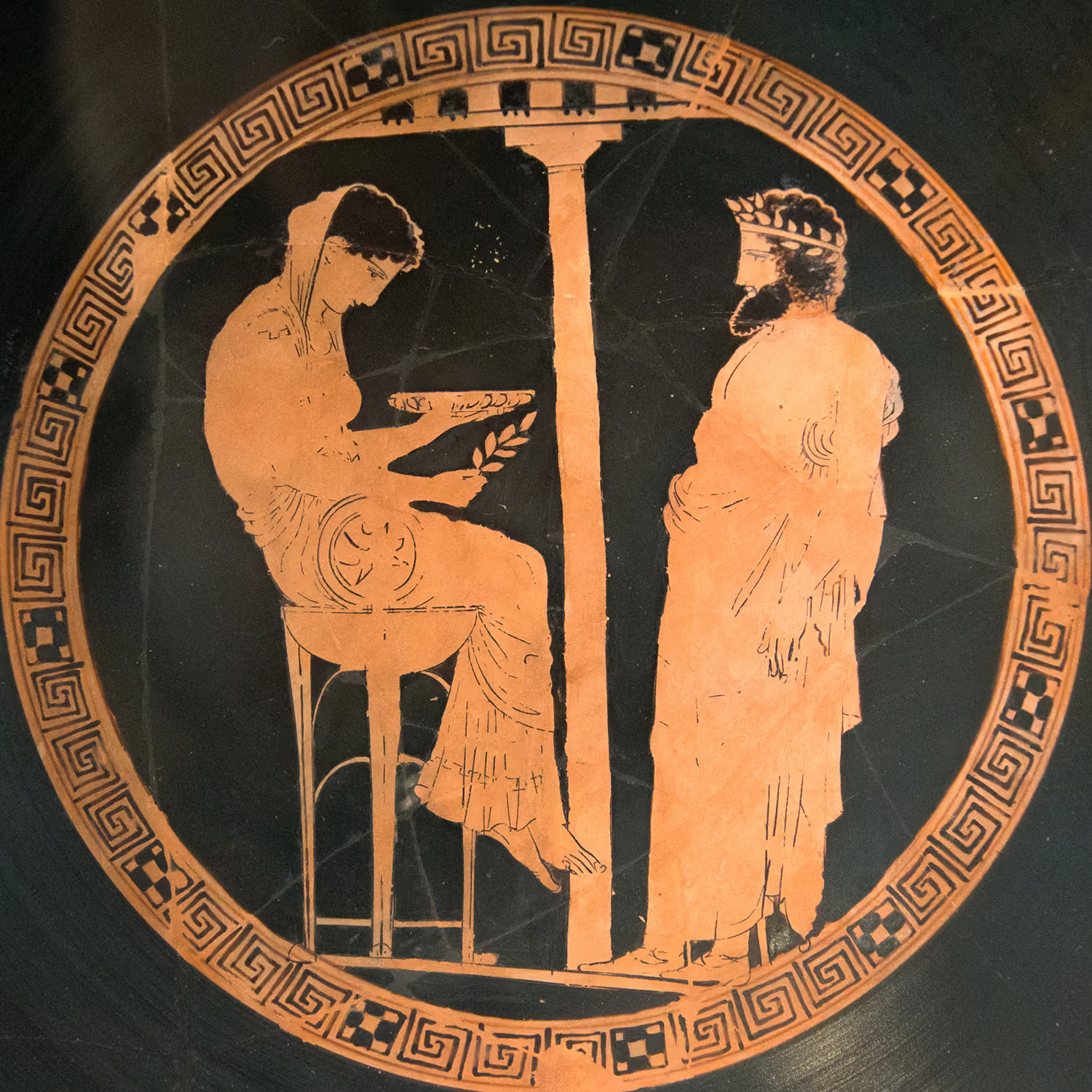
In antiquity, an oracle was a trusted conduit between the human world and hidden truth. In crypto, an oracle plays the same role: delivering offchain facts to onchain code. Oracles feed smart contracts all sorts of data: market prices, weather data, random numbers, times and dates, cross-chain messages, and real-world event outcomes. This expands their scope to DeFi lending, insurance, prediction markets, derivatives, stablecoins, gaming, and much more.
But the real world is complex, and the oracles that connect it to blockchains are too.
In this post, we’ll take a comprehensive look at oracle security, where oracles tend to fail leading to hacks, how to design defenses against these hacks, and the tools available to help you do so.
Note: this post is about blockchain oracles in DeFi and crypto, not cryptography’s padding oracle attack, which is a different vulnerability class.
How Blockchain Oracles Work
At its simplest, an oracle does one job: it turns offchain facts into onchain data. Smart contracts can then consume that data. The main architectural choice that matters regarding oracle selection is whether to use a centralized or decentralized oracle network.
A centralized oracle is one reporter. A single service that hopefully pulls from a few different sources and posts directly to the chain. It’s fast to build and cheap to run. It’s also a single point of failure. If that service goes down, gets censored, or just produces a bad number, your contract inherits the mistake. There’s no objective way to out-vote an error because there’s nothing to vote with – only one voice exists. Picture a server that calls a single API and publishes that result onchain: that’s a centralized oracle.
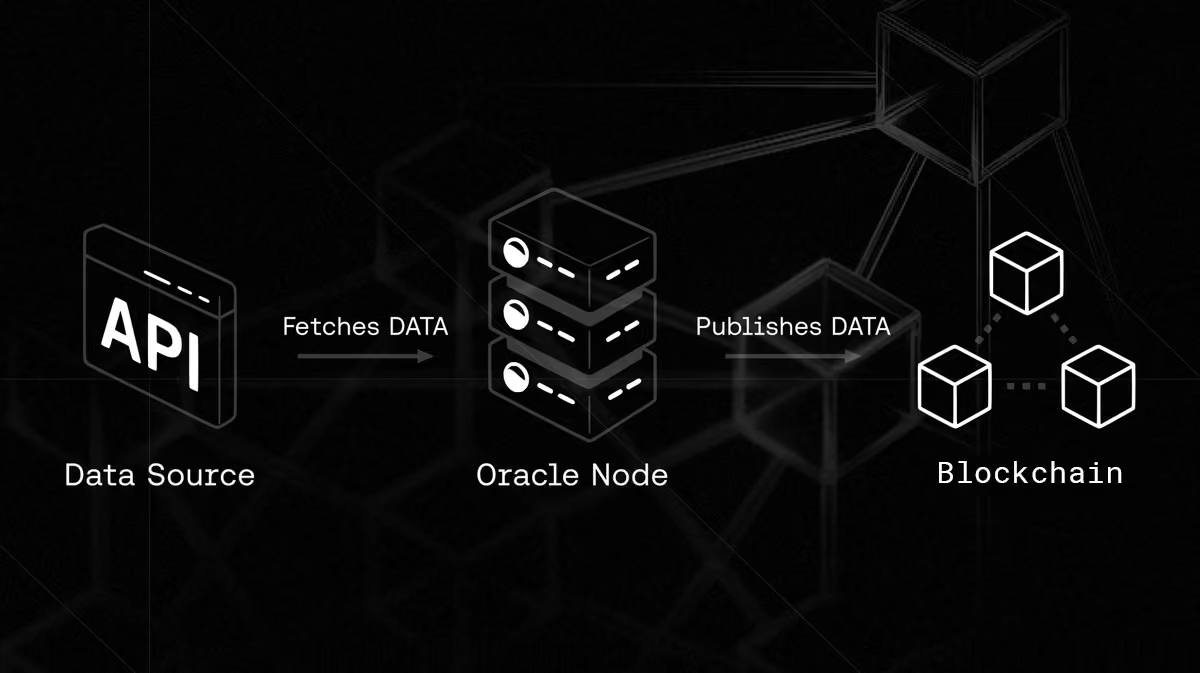
A decentralized oracle network (DON) replaces the single reporter with many independent node operators pulling from diverse data sources. Each node submits a report and the network aggregates them. Typically, this is done by medianizing the reported results. The network then adds metadata like the round ID and timestamp, and publishes the result on-chain. This structure is resilient in ways a single reporter can’t be. Outliers and malicious nodes get medianed away, and multiple data sources are aggregated to provide a more resilient report.
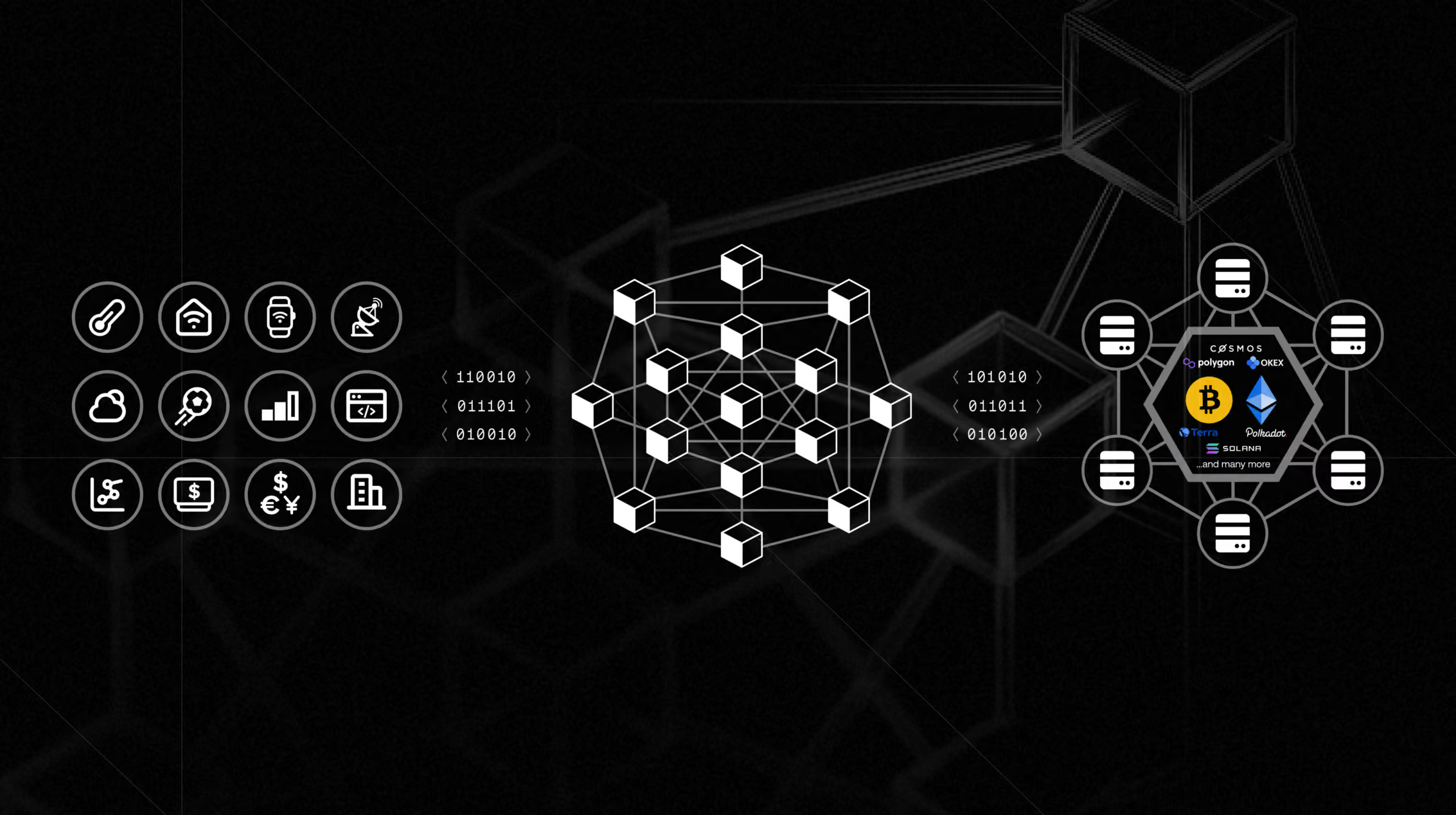
From a smart contract’s perspective, both models look similar – a call returns a number and some metadata – but the trust story is different. With a centralized oracle you must trust one machine and its operator. With a decentralized network, you trust the mechanism: heterogeneous sources, independent reporters, and aggregation that tolerates faulty participants.
The whole point of blockchain is to minimize trust requirements and arrive at a distributed consensus. Decentralized oracle networks are a natural fit, especially when they can be customized to meet a user or application’s individual needs and security budget.
Where Oracles Fail
Smart contracts treat data from oracles as facts. If the oracle is wrong, late, or misconfigured, the contract will still execute as if nothing is amiss. That’s why many DeFi oracle exploits start here, not in the business logic, but in the data feed. Auditors flag these issues constantly, as oracle miswiring and stale feeds are among the most common findings in smart contract audits.
Five failure modes recur often:
- Stale feeds and missing heartbeat checks
If a contract doesn’t compareupdatedAtagainst the asset’s defined heartbeat (as published for Chainlink oracles), it may treat outdated data as fresh. This has led to liquidations and mis-pricings during volatile periods.
- Sequencer downtime on layer-2 rollups
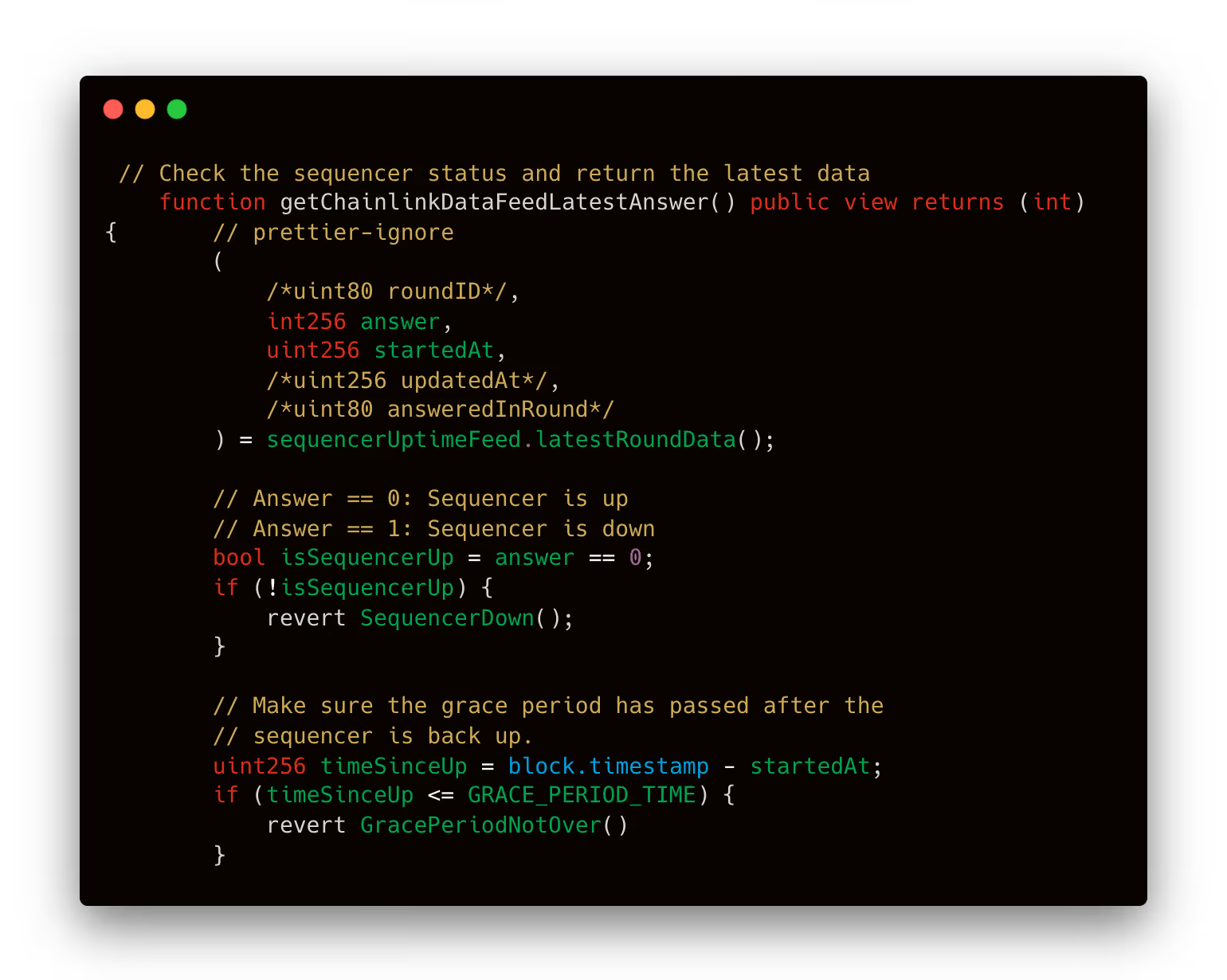
On L2 rollups like Arbitrum and Optimism, feeds can look fine even if the sequencer is paused. Without a sequencer health check, contracts may keep accepting data that isn’t actually being updated. This isn’t an oracle-side bug per se, but it does impact prices and data reported by oracles.
- Global policies that ignore asset volatility
Teams often reuse the same heartbeat or deviation threshold across all feeds. A volatile small-cap token may well need a far more frequent heartbeat than BTC or ETH.
- Aggregator misconfiguration
Oracle feeds are just contract addresses. Pointing at the wrong one will return technically valid but irrelevant prices.
- Decimal errors
Feeds return an `answer` with specific `decimals()`. If you assume 18 decimals but the feed is only reporting 8 (or, for example, mix ETH/USD with USD/ETH), you misprice by nine orders of magnitude.
Oracle Hacks in the Wild
Attackers don’t need zero days when they can weaponize market microstructure and oracle assumptions. The playbook is consistent: create a brief distortion, get that distortion synced into the price oracle, then extract value via borrow/mint/liquidate before prices normalize.
The attack patterns below map to three types of oracle hacks you’ll see again and again.
AMM manipulation with thin liquidity
Automated market makers (AMMs) are easy to move when liquidity is thin. With sufficient capital, an attacker can push the price of a token up or down for a single block, just long enough for a price oracle (e.g., short-window DEX TWAP) that relies on that pool to record the distorted price. If that oracle feeds into a lending protocol, the attacker can mint excess collateral or trigger liquidations at will.
Flash loan exploits in price oracles
Attackers can also borrow massive amounts of capital via flash loans to even overwhelm markets that aren’t catastrophically illiquid. Inflating the reported value of their collateral then lets a malicious user borrow more assets against this collateral than they should be allowed to, leaving the protocol with bad debt once the price normalizes. New Gold Protocol’s $2M loss on BNB Chain is a recent example, where a broken oracle setup let attackers weaponize a flash loan to drain reserves.
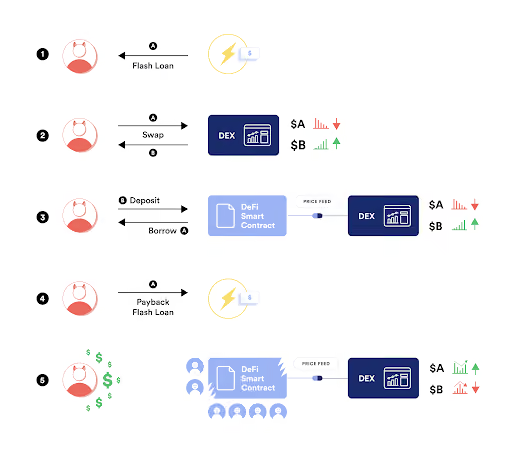
In June 2024, UwU Lend suffered when a Curve pool was pushed off-balance, and its price oracle reflected that distortion. The attacker minted inflated collateral and drained funds before prices settled back. This was the same attack pattern that Inverse Finance and Harvest Finance had suffered in earlier years.
Randomness corruption in games and NFTs
Blockchain oracles also supply verifiably random numbers for games, lotteries, and NFT mints. If randomness isn’t derived securely (for example, if it can be predicted from block data or influenced by miners/validators), attackers can tilt odds in their favor. SpeedRunEthereum offers a deliberately vulnerable contract in a training environment that illustrates how using blockhash for randomness allows an attacker to predict outcomes.
Designing Defenses
Once you know how oracles can fail and how attackers exploit them, the question becomes: what can you do in practice to harden your blockchain oracle security? The good news is that most defenses are conceptually simple.
Using dual-oracle designs for redundancy
Don’t trust a single source of truth. Pair a primary oracle feed (like a Chainlink price feed) with a secondary reference, such as a DEX time-weighted average price (TWAP). If the two disagree by too much, halt or fall back. For example, Compound’s Open Price Feed module uses Chainlink but also checks against Uniswap average price.
Enforcing deviation thresholds in code
Add explicit guardrails in code. If abs(primary – secondary) > X%, the contract should either pause sensitive functions (minting, liquidations) or switch to the fallback oracle. Exact X% is a policy decision: too tight, and normal volatility will freeze your protocol; too loose, and attackers have room to maneuver. Historical exploits (like Inverse Finance in 2022) show how generous thresholds can be stretched.
Adding sequencer guards on rollups
On rollups like Arbitrum or Optimism, you need to account for sequencer downtime. Even if a feed appears live, no new blocks are being confirmed, which means prices aren’t really updating. A simple sequencer health check (e.g., Chainlink’s Sequencer Uptime Feeds) lets you block oracle-dependent functions until a grace period has passed after the sequencer restarts. This prevents users from interacting with stale data during outages.
Creating per-asset oracle policies
Every token is different. A large-cap asset like ETH can tolerate longer heartbeats and wider deviation thresholds than a volatile token under stress. Yet teams often copy-paste one global policy across all assets. When the Chainlink LUNA price feed was paused during its collapse, protocols that hadn’t applied asset-specific safeguards lost millions. The pause was a pre-defined safety control, the failure came from not handling a paused feed and stale oracle price. The fix is to maintain a config file with heartbeat, deviation, and max-age values tuned per asset, and enforce it in code.
How Octane Protects Against Oracle Attacks
No team wants to lose sleep over whether they missed a stale-feed check or miswired a contract. Oracle security tooling won’t remove the need for discipline, but it can make the right choices easier to apply consistently.
Octane provides:
- Static analysis in smart contract security
Before deployment, Octane scans contracts for the most common oracle integration misses: noupdatedAt`guard, blanket heartbeat constants reused across assets, or aggregator addresses that don’t match the canonical registry. Catching these at compile time is cheaper than debugging them in production. - Automated synthesis of config files
Instead of copy-pasting heartbeat and deviation numbers from docs, Octane can auto-generate policy files with per-asset values from official oracle docs (heartbeat, deviation, decimals). That reduces the risk of ETH-sized thresholds accidentally governing a thin-cap token. - Scenario fuzzing
In staging, Octane can replay hostile conditions – AMM depth traps, sequencer pauses, stale-feed drift – and verify that your deviation guards, pause hooks, and fallback logic fire correctly. It’s a way to prove defenses work under stress rather than just trusting code review. - Oracle-Specific Detectors
Octane’s suite of specifically-trained detectors includes a number that are focused on oracle-specific vulnerabilities. These detectors have been trained on the patterns and best practices described above.
Verify Your Oracle Integrations with Octane
If your contracts treat oracle inputs as facts, make those facts hard to fake.
Octane checks your oracle configuration and policies, then simulates real attack conditions to prove your safeguards work.
Schedule a demo today to see the Octane platform in action.
.png)
Subscribe to our newsletter