
Complex Threats Hidden in Modern Protocols
Ask any founder what keeps them up at night before a mainnet launch. Chances are, it's something like this: “What if there’s a deeply complex vulnerability hiding somewhere in the system that no one noticed?”
Onchain systems today aren’t simple anymore. They’ve evolved into sprawling, interconnected architectures with dozens of contracts, intricate libraries, upgradeable patterns, nested dependencies, and execution paths that shift with every new PR. As these systems grow more composable, the vulnerabilities that stay hidden aren’t simple. They’re the strange, multi-step ones.
These are the vulnerabilities that live five layers deep in a dependency/inheritance chain, or emerge only when two or three contracts interact in a specific sequence. They hide in logic paths most developers wouldn't test, and in code that appears harmless until the right combination of conditions aligns.
This is why founders fear them: you can do everything right — great auditors, great testing, great reviews — and still miss them. You can spend over half a million dollars on one deployment, and still miss it. Not because anyone is careless, but because the systems you're building have outgrown what traditional smart contract security methods can reliably see.
Why Complex Bugs Are Becoming More Common
If it feels like complex bugs are showing up more often than ever, it’s because they are. Not randomly, but structurally. Modern protocols are designed for flexibility, composability, and speed. Those strengths come with a hidden cost: exponential increases in complexity. We’ve already seen this play out in 2025 with the complex exploit of Balancer and the impact across multiple chains.
Here’s what that looks like in practice:
- Modular architectures create hidden interactions: Every additional contract, library, or module multiplies the potential paths for data and control flow. A bug may not exist in any single file, but only in the way those files interact. Many contracts today inherit others, then call complex dependency call-chains to perform non-trivial interactions such as cross-chain message initiations with LayerZero, CCTP calls, etc.
- Dependency trees are getting deeper: Teams reuse code, import utilities, wrap logic, and external party code (oracle adapters, ERC standards, proxy setups, etc). Some of the most dangerous behaviors live several layers down, far from the visible surface. At Octane, we’ve seen interesting vulnerabilities where contract A inherits contract B, and A overrides an internal method called by B, which then calls contract C (another dependency), yielding bugs between the connection of B and C.
- Proxies require careful configuration: Proxy patterns are powerful, but they also must be handled with care as they create a new surface area for exploits. For example, we’ve saved users from forgetting to override critical methods for safe proxy configuration, such as _authorizeUpgrade on UUPS proxies.
- Codebases change fast: Frequent PRs continuously introduce new state flows and new interactions that didn’t exist when an audit was performed. This is called an audit diff, and the code shouldn’t be deployed until it receives an AI scan, testing, and a manual audit, but often, devs forget this.
When the complexity of a system accelerates, complex bugs become inevitable, not as an edge case, but as a byproduct of building ambitious protocols.
Why Complex Vulnerabilities Are Consistently Missed
If complex bugs are becoming more common, then it’s time to ask the real question: how do we stop them at scale? Modern protocols operate with dozens of inherited contracts, shared storage layouts, proxies, batched calls, cross-chain interactions, and state-dependent logic interacting in nonlinear ways.
Humans can reason about linear flows, but not thousands of branching execution paths that only become dangerous when combined. Layer in scope constraints, fast-moving codebases, and assumptions scattered across different contracts, and it becomes impossible for any reviewer to mentally simulate how the entire system behaves across every edge case. Complex bugs live in those blind spots.
Basic tools struggle for the same reason: they aren’t built to understand full-system behavior. Most scanners match patterns or evaluate contracts independently. They don’t trace deep dependencies or analyze inherited code. They can’t interpret protocol-specific business logic or rare state combinations that create exploitable conditions.
The result is simple: complex vulnerabilities are the ones that slip through. This is why founders worry about blind spots, why attackers increasingly exploit multi-step interactions, and why visibility into system-level behavior has become essential for smart contract security.
How Top Teams Catch Complex Bugs Before Launch
Top teams build with a security-first approach from day one. They have accepted a simple truth: in modern protocols, complex bugs aren’t rare. They exist, they’re in the code, and we have to find them. What separates the best teams from everyone else isn’t that they avoid complexity, but that they build their entire development and security process around surfacing the kinds of vulnerabilities most likely to hide.
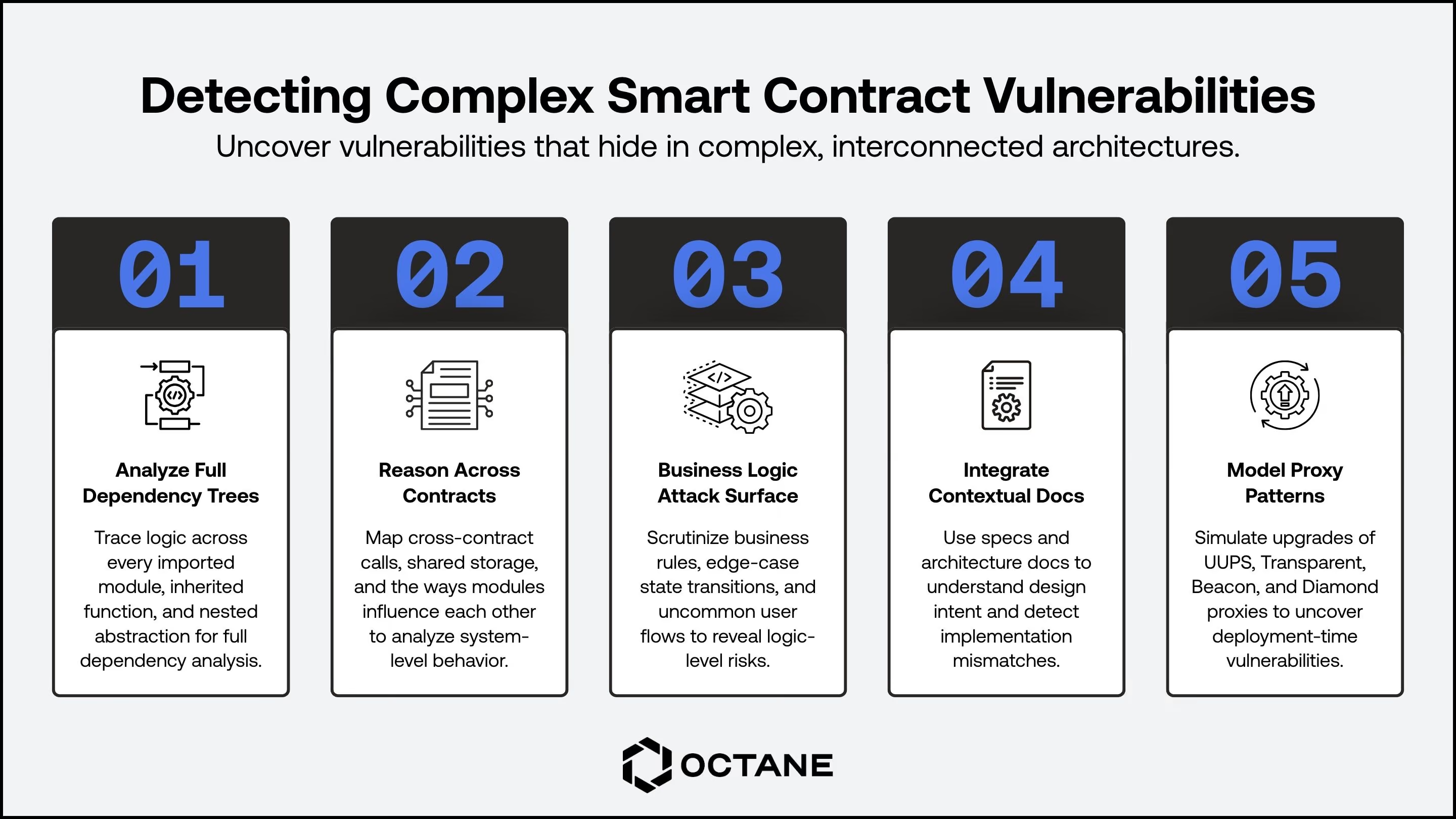
They analyze full dependency trees, not isolated files
Security-first teams never stop at the contract in front of them. They trace logic across every imported module, inherited function, and nested abstraction, because the most dangerous bugs often originate far from the main entry point. By understanding the whole dependency tree, they catch issues that would stay invisible in a file-by-file review.
They reason across contracts as a whole system
Instead of evaluating contracts one at a time, top teams think in terms of system-wide behavior. They map cross-contract calls, shared storage, and the ways modules influence each other. Many complex bugs only appear when multiple components interact in a specific order, and only a whole-system view reveals them.
They treat business logic as an attack surface
Top teams know their most unique features can become their most unique vulnerabilities. They scrutinize business rules, edge-case state transitions, and uncommon user flows, because logic-level flaws rarely resemble classic vulnerabilities. When logic is complex, logic itself becomes the risk.
They run continuous analysis on every PR
A single pass over a codebase provides a moment-in-time snapshot. Complex bugs often only emerge after repeated analysis, as context accumulates or the code evolves. Top teams revisit the system continuously with every PR, every upgrade, and every architecture change because complexity shifts over time, and visibility needs to shift with it. Also, if you put the best auditor in the world in a room for 5 days to review a single codebase, they’ll find a bunch of bugs. But if you put that auditor back in the room and erase their memory, they’ll probably find another set of bugs that are only partially overlapping with the previous review. Thus, for every new code analysis you perform across manual auditors or AI systems, you should expect to find net new bugs and overlapping issues previously found. This is why it's important to always run continuous analyses because they can net new bugs.
They expect complex bugs and use tools to surface them
The biggest differentiator is mindset. Top teams assume complexity hides something, and they don’t rely on traditional methods alone to find it. They adopt tooling and processes designed to expose cross-contract, state-dependent, multi-step vulnerabilities that humans and basic tools could miss.
Example #1 - Complex Vulnerability: Phantom Multicall
The Phantom Multicall vulnerability Octane uncovered in Covenant is a perfect example of how dangerous interactions can hide across inherited contracts. Covenant.sol custodies the protocol’s base token reserves and accrued fees, but it also inherited a permissive multicall implementation.
By simulating execution with msg.sender == Covenant, Octane showed that an attacker could use multicall to execute arbitrary external calls as Covenant itself. This allowed direct invocation of ERC-20 functions like transfer, transferFrom, or an approve → transferFrom sequence, draining Covenant’s token balances with no allowances or signatures. The vulnerability didn’t come from a single contract; it emerged only when inherited authority and custodial logic combined during a batched call.
Octane recommended restricting multicall targets to trusted contracts, blocking unsafe selectors, and requiring explicit authorization for state-changing external calls.

Example #2 - Complex Vulnerability: Liquidating Safe Positions
A recent Octane analysis of a decentralized betting protocol uncovered a subtle logic flaw in its liquidation engine. The contract accepted a caller-supplied gameMarketId and a list of positionIds, then evaluated and updated each position using that supplied game, but never verified that position.gameMarketId == gameMarketId.
This created a dangerous cross-contract interaction. If Game A’s price feed showed a position as underwater while Game B’s did not, an attacker could liquidate a Game B position using Game A’s state, seizing funds and updating protocol accounting under the wrong market.
Octane’s fix enforced game-to-position binding at both layers of the system. The liquidation engine now checks each position and throws a mismatch when IDs don’t align, and the base market contract rejects any update with a mismatched game. Cross-game batches now revert, ensuring liquidation and accounting only occur for positions belonging to the correct market.
Octane Specializes in Complex Bug Detection
Octane is designed for the types of vulnerabilities that emerge only in complex, interconnected architectures. Rather than looking for surface-level patterns, it builds a deep, evolving understanding of how your entire system behaves across contracts, state transitions, and execution paths. Each capability is purpose-built for the areas where complex bugs originate.
Deep Dependency Analysis
Complex bugs often start far from the top-level entry point. They start inside inherited contracts, shared libraries, or nested abstractions that influence logic several layers downstream. Octane traces these full dependency chains automatically, mapping how data and authority move across every linked contract. This reveals vulnerabilities rooted in deeply buried behavior that would otherwise remain hidden.
Cross-Contract + Cross-Component Logic
Real vulnerabilities frequently emerge not within a single contract, but when multiple contracts interact. Octane analyzes execution holistically, following how calls propagate, how state updates flow between contracts, and how inherited behavior shapes downstream effects. This system-wide visibility makes cross-contract logic issues directly observable.
Rare Business Logic Flaws
Many critical vulnerabilities arise from a protocol’s unique rules, not from generic patterns. Octane evaluates your business logic as part of the security surface, exploring how edge-case states, unusual call sequences, or specific economic conditions can produce unintended outcomes. Since it understands your system’s actual behavior, it surfaces logic-level issues that only appear under rare or nonlinear circumstances.
Repeated Analysis Through CICD
Some complex bugs only emerge when small low or informational issues stack up over time and become easier to exploit, escalating severity. Octane continuously re-analyzes the system through CICD, layering new context onto previous runs and identifying vulnerabilities that become visible only after repeated inference. Over time, its understanding of the architecture becomes richer and more precise, allowing it to detect behaviors a one-time evaluation would never reveal.
Run Octane On Your Code Today
The most dangerous vulnerabilities in protocols today aren’t obvious mistakes. They’re the hidden interactions that only appear when contracts, inheritance, and state transitions collide in unexpected ways.
Octane gives teams visibility into the deep dependencies, inherited permissions, authority flows, and edge-case logic where complex bugs take shape. It’s the same visibility that surfaced Phantom Multicall and protected Covenant’s protocol and user funds before launch.
If your protocol is evolving, composable, or upgradeable, you already have complexity. Run Octane before your next deployment and see what that complexity is hiding.

Subscribe to our newsletter