Beagle, the renters insurance compliance platform, automates away a category of work that has long been one of the most time-consuming and error-prone in property management.
Beagle's mission is, at its core, a disappearing act. The platform promises to "make insurance compliance invisible — so property managers never think about it again." No more chasing tenants for proof of coverage or reconciling policies by hand.
But this disappearing act only works if everything is running smoothly behind the curtain. Beagle maintains a complex backend that holds the tenant rosters of more than 1,000 property managers and over 300,000 units. It verifies third-party insurance policies in real time, resolves tenant identity across messy property management system (PMS) data, and produces the billing artifacts that property managers feed back into AppFolio and other PMS platforms to apply the right charges to the right tenant accounts.
Beagle brought in Octane to analyze its risk surface, find what an attacker could exploit, and deliver validated findings with clear fixes. AI-native analysis makes that possible without burning through a quarter of engineering time.
Securing the Differentiator
Companies building AI-native products generate a dynamic attack surface faster than traditional AppSec can audit it, and the risk is qualitatively different from what legacy tools were trained on.
Protecting that surface is not a job point-and-scan tooling is equipped to handle. Neither, however, are raw frontier models: without expert, security-focused architecture, they produce a massive volume of findings with minimal judgment.
As Jad Ashkar, Beagle's CTO, puts it: "A model can surface a thousand findings, but knowing which ones truly matter is the hard part."
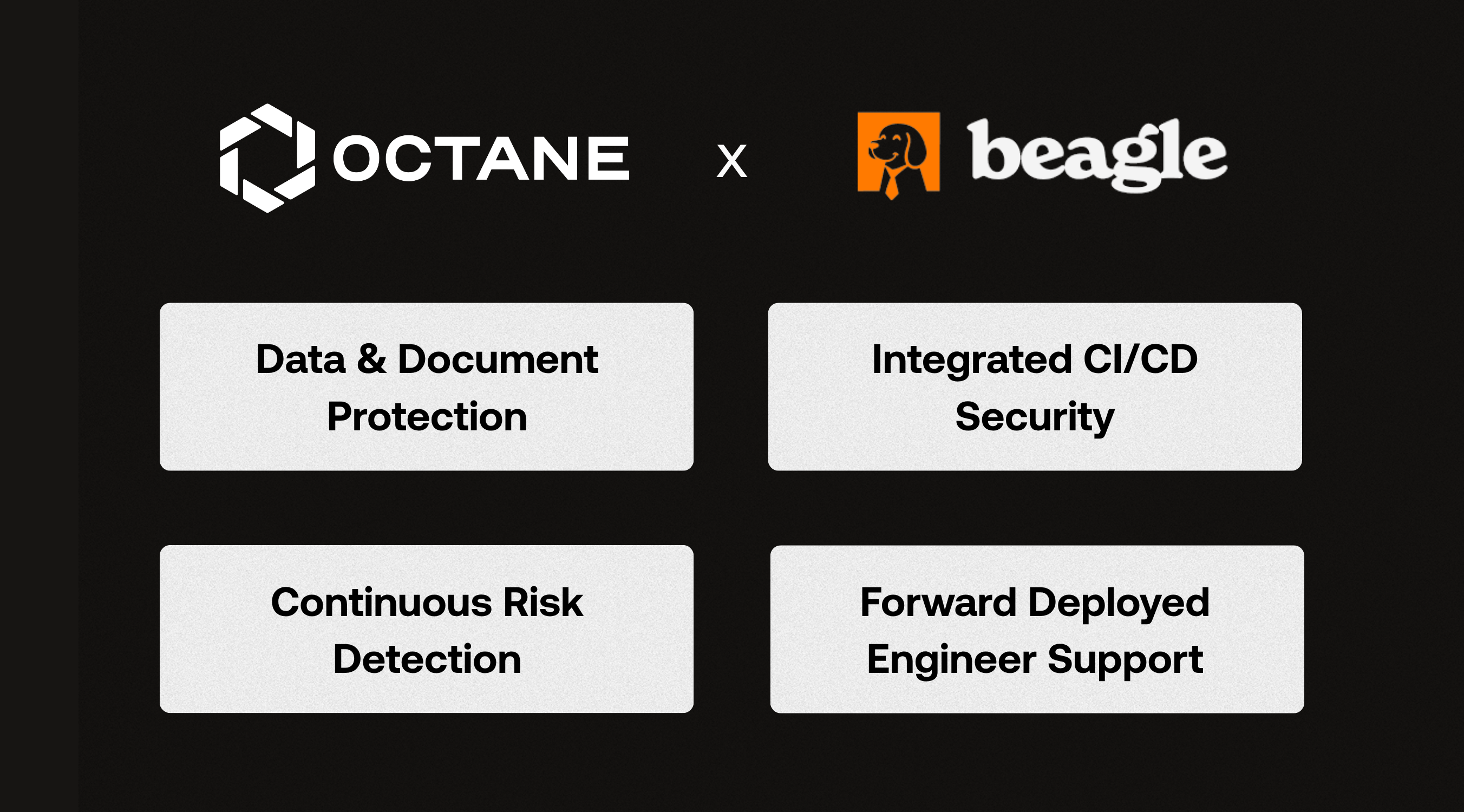
Working closely with Beagle, we focused our engagement on this differentiator. What Beagle got was continuous, AI-native AppSec integrated directly into the development cycle, directed exactly where it matters most.
"For teams building critical financial infrastructure and handling sensitive data with an AI-native approach, it’s imperative that security be integrated directly into development workflows. Beagle moved from initial analysis to full remediation in days, strengthening their entire platform. We're excited to support Beagle as they continue to grow."
– Giovanni Vignone, Founder and CEO of Octane
Findings and Fixes in Days, Not Weeks
With Octane, Beagle went from first scan to full remediation before a traditional audit would have finished scoping.
Octane’s AI-native security analysis engine traces thousands of execution paths through the entire codebase, validates exploitability, and hands each finding to a security researcher who walks your team through the severity, likelihood, and fix.
“What I appreciate about Octane is that the researchers shaping the model are the same people breaking down the findings and working through the fixes with you. Everything from onboarding to the delivery of findings to their final resolution was seamless. Octane is a perfect fit for our AI-native approach, and I’d highly recommend it to anyone building systems that handle sensitive data."
– Jad Ashkar, CTO at Beagle
Quarterly Audits Don't Cut It
Beagle abstracts away the complexities of insurance compliance for property managers, and Octane provides the secure foundation that makes that invisibility trustworthy.
For an automated compliance platform that handles rent ledgers, PII, and AI-driven approval decisions for 1,000+ property managers, the foundation cannot be a point-in-time audit or a model dumping findings into a dashboard nobody ever visits. It has to be a continuous loop that catches the bugs that survive code review, the ones that compound silently, and the novel vulnerabilities like prompt injection and model-boundary failures that didn't exist five years ago.
Bugs in AI-native software don't wait for your next quarterly audit.

Subscribe to our newsletter